
Livingston County Busted Mugshots
A booking photo gets taken when someone is arrested. Police or the Sheriff log the first entry. If the person lands at the Livingston County Jail, a second custody record opens there. Strung together, these entries can tie the arrest time, the charges as recorded, the custody receipt, and any later release or transfer into one trail.
Several offices hold pieces of it. Sheriff Ryan Bohm heads the Sheriff’s Office, which runs county law enforcement and routes records requests. The county Jail explains custody, contact, and a Federal Marshals detention arrangement, though it offers no name search or photo roster. Pontiac, Dwight, and Fairbury each keep their own arrest and incident records. Courts add hearings, charges, and sentences later through the Circuit Clerk and Judici.
That split is why one search rarely settles everything. A city officer makes the arrest. The jail takes custody. The person may transfer to state or federal hands before any court entry appears. Locals say busted when they mean a reported arrest or booking. For a reliable starting point, the current Sheriff page lists the agency contact block and partner routing. Treat it as an office doorway, not a gallery of faces.
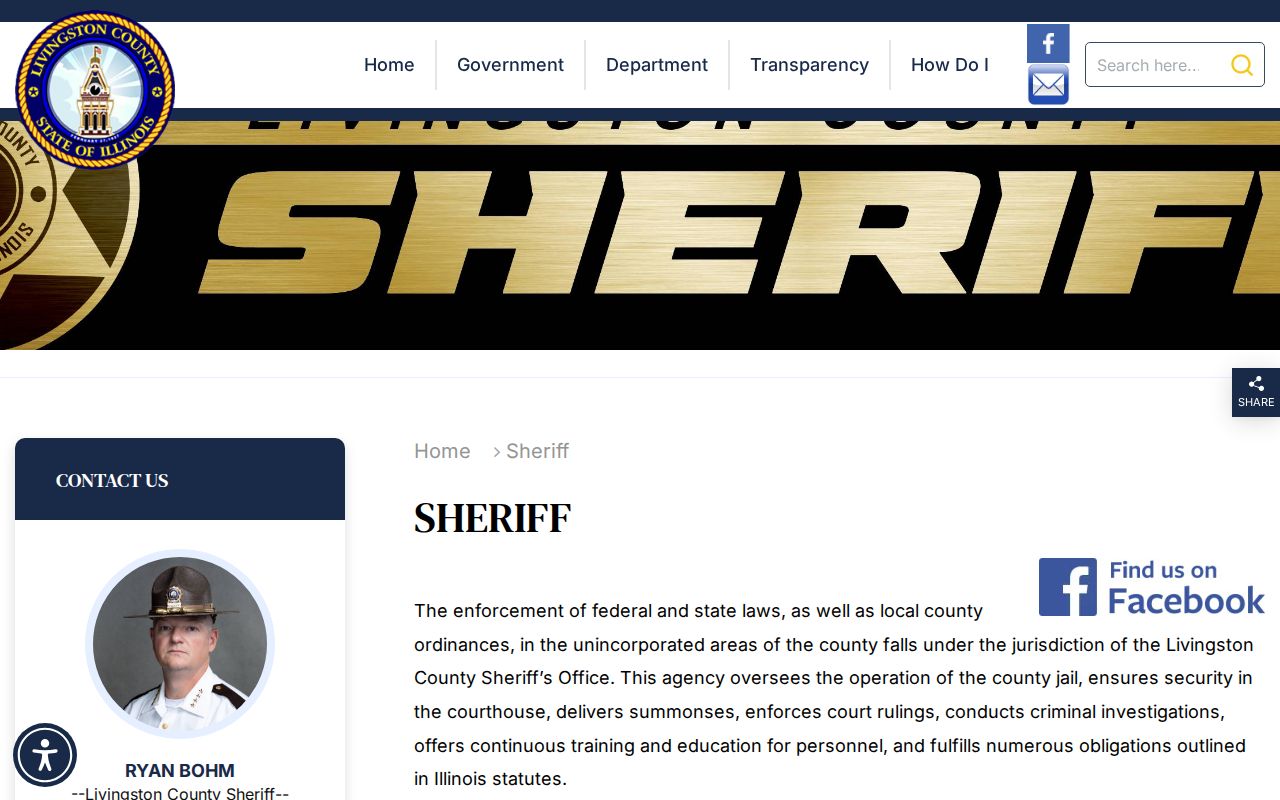
The Sheriff page points to official offices rather than a wall of faces. That matters, since the county’s public pages do not confirm any live online booking-photo feed.
Livingston County Booking Record Fields
Illinois sets a baseline for arrest data through 5 ILCS 140/2.15. The statute names the person’s name, age, address, photograph if available, charges, arrest time and place, arresting agency, and the date and time of custody receipt plus discharge or transfer. It also sets a clock. The information should go out as soon as practical, and no later than 72 hours after arrest unless an exemption applies. That deadline is a timing rule. It is not a promise that Livingston County will post a web roster.
The county publishes no current booking-field list or public results screen. The table here splits fields the statute supports from items that may exist only inside a jail or police system. When you write a request, add “if maintained” for optional fields. For a photo, ask for it “if available and releasable.”
| Field | What it can show |
|---|---|
| Full name and age | The identity and age recorded for the arrest event. |
| Address | The address held in the arrest record, subject to exemptions. |
| Photo | A booking or arrest photograph, if one exists and can be released. |
| Charges | Charges recorded at arrest or intake, not a final court result. |
| Arrest time and place | When and where the arrest happened. |
| Arresting agency | The Sheriff, a city police department, ISP, or another agency. |
| Custody received | When the jail or agency accepted the person into custody. |
| Discharge or transfer | When county custody ended or moved to another custodian. |
| Booking or case number | A local tracking number, if the agency maintains one. |
| Bond or release condition | A court-set release term, which may be held outside the intake record. |
| Court date and disposition | Later court events, best checked through Judici or the Clerk. |
“Disposition” is the later outcome of a case. That could be dismissal, acquittal, plea, or conviction. A jail record can prove intake while saying nothing about the disposition. A court record can show the case yet never reproduce the booking photo. Each custodian holds a different slice.
Livingston County Busted FOIA Requests
The Livingston County FOIA page asks that requests be written and specific. You can mail, fax, email, or hand-deliver them. The county says it answers within five business days. The first 50 black-and-white letter or legal pages are free. After that, $0.15 per page applies. So ask about current charges before ordering color copies or a large set.
Sheriff-held arrest and booking records go through FOIA officer Hilary Bauman at the Public Safety Complex, 844 W. Lincoln Street, Pontiac, Illinois 61764. The listed email is sheriffbusiness@livingstoncountyil.gov. The office number is 815-844-2774. The county hosts a current FOIA form plus a Sheriff-specific form. A city arrest may still need its own request to that police department.
Livingston County Sheriff FOIA
Hilary Bauman, Sheriff FOIA Officer
844 W. Lincoln Street
Pontiac, IL 61764
815-844-2774
sheriffbusiness@livingstoncountyil.gov
Livingston County Jail
Public Safety Complex
844 W. Lincoln Street
Pontiac, IL 61764
General information: 815-844-5774
Administration: 815-842-8079
Use the jail line for current-custody routing, not as a public search result.
A precise request helps the records officer find the right event fast. Ask for the record itself, not for the office to write a new report.
- Identify the arresting agency, person’s full name, approximate date, and place.
- Request the arrest fields, charges as recorded, custody receipt, discharge or transfer time, and a photograph if available and releasable.
- Include a case, incident, or booking number when known, and use a date range for a common name.
- Ask for nonexempt portions if part of a record must be withheld.
- Save the delivery date, response, fee notice, and any reason given for withholding.
For older or already-released records, put the request in writing rather than relying on a phone answer. A written ask documents exactly what was sought. It also lets the custodian forward the request when the Sheriff does not hold the record.
Records note: “Photograph, if available” is the careful request language. The county has not promised that a photo is kept online or released by phone.
Illinois Busted Mugshot Law
Illinois draws its rules from 5 ILCS 140/2.15, which treats arrest data as a public-record category while leaving room for exemptions. The statute sets juvenile limits. It also bars lower-level booking photos from social-networking sites unless an exception applies. A formal request to a custodian and a social-media post travel through different channels. So a photo missing from Facebook tells you nothing about whether a record exists.
A separate correction rule sits in 815 ILCS 505/2QQQ. That law makes it illegal to charge a fee for removing, correcting, or changing criminal-record information, subject to its listed exceptions, and it lays out how inaccurate material gets fixed. Start with whoever holds the source. That may be the Sheriff, the jail, the arresting police agency, or the court. Keep official proof of any corrected disposition or court order close at hand.
Expungement and sealing work through the courts under 20 ILCS 2630/5.2. Whether a case qualifies turns on the charge, the sentence, supervision, later history, and statutory exclusions. Current approved paperwork, including forms approved in June 2026, is posted on the Illinois Courts forms page. An order can direct agencies to act. Still, it will not reach every copied page or cached search result on its own.
On the private side, the verified Mugshots.com county page posts a record-maintenance policy. It covers free, document-based requests tied to expungement, sealing, restriction, no-information, identity-theft, or death records. It may update a favorable disposition rather than wipe every entry. RecentlyBooked's general policy likewise states that qualifying correction or removal requests cost nothing. Its Illinois list showed no active Livingston section. Neither publisher policy is legal advice for Illinois, and neither proves a local page exists.
Busted Newspaper showed no verified Livingston page. No local policy could be established for the absent Arrests.org or Mugshots.zone paths. Fix the source record first. Once an agency or court changes it, a person can send official proof to any copied publisher. Google's outdated-content tool may refresh a search result after that change. Still, it cannot erase what the police, jail, court, or publisher still holds.
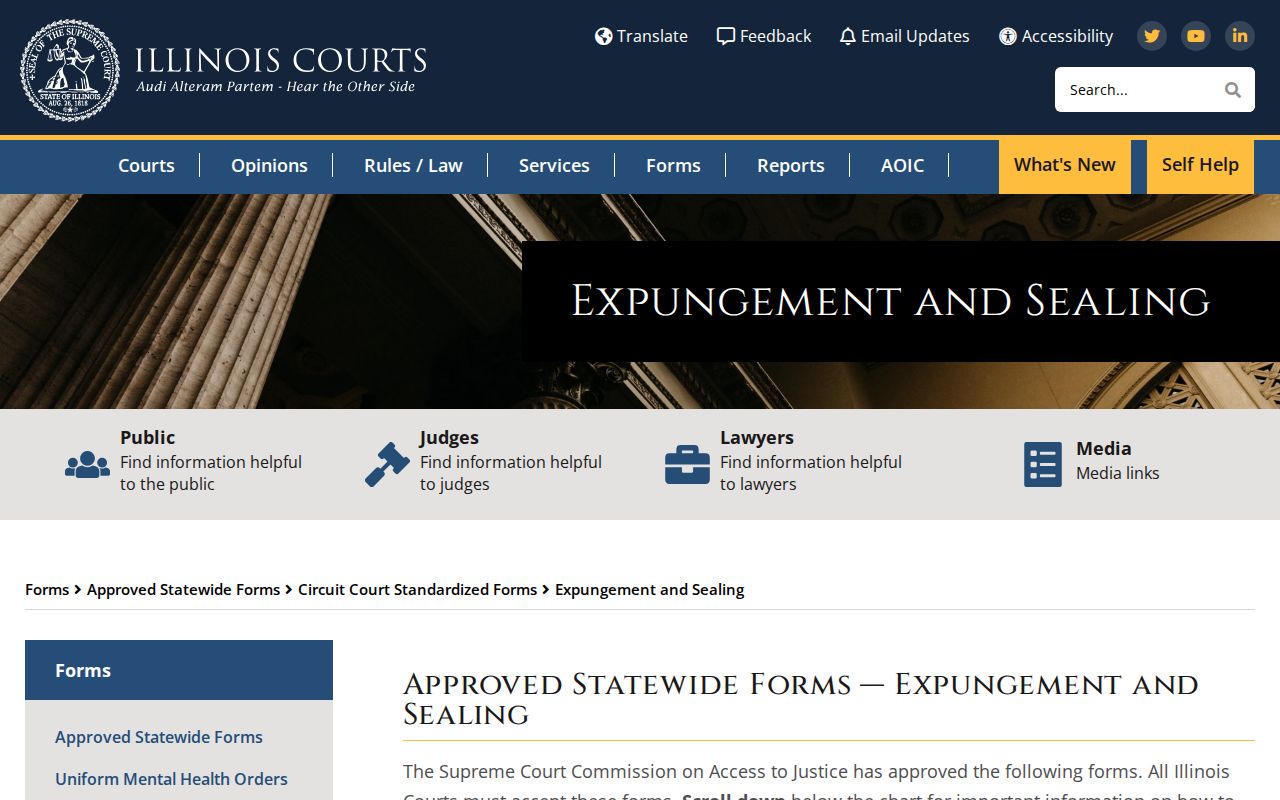
The official court capture shows the lawful form route in practice. When a case result changes, the path runs through the court first. An attorney or legal aid can do it too. Any publisher still carrying the old entry gets notified afterward. The filed proof is attached to that notice.
Old Livingston Busted Records
No county source says how long a booking photo or jail entry stays online. Retention was simply not documented. A third-party page can stay searchable long after the county page disappears. An older official record may still sit with the agency or under an approved records schedule. History is a different story. The Illinois State Archives IRAD listing points to Livingston County Sheriff Jail Registers, 1906 through 1955, accession 3/0051/05, kept at Illinois State University. That collection is a paper register, not a digital mugshot archive. For anything current, ask the Sheriff records officer. Find out whether the record exists and which approved schedule governs it.
| Record age or status | First route |
|---|---|
| Current county custody | Call the Livingston County Jail at 815-844-5774 for the current public procedure. |
| Recent city arrest | Ask the arresting police department for its record and photo request path. |
| Released county booking | Send a specific Sheriff or Jail FOIA request. |
| Later court result | Search Judici with court code IL053015J, then ask the Clerk for official copies. |
| 1906 to 1955 jail register | Use the IRAD and Illinois State University historical reference route. |
Illinois records-management guidance is clear on one point. A local agency needs approved disposal authority before destroying anything. A web page vanishing does not create a retention period. Ask the custodian directly. Then preserve whatever answer comes back for a correction or archive request.
Find Livingston County Busted Mugshots
No single Livingston County screen covers everyone. A just-booked person, a current inmate, a released booking, a state prisoner, and a federal detainee each live in different systems. Start with the custody status. Then check the arresting agency. That habit keeps a state-prison profile from being read as a county booking photo, or a news story from being read as a live roster entry. The county office comes first in the practical order below. The current Sheriff and Jail pages show no public roster or feed. From there the trail runs to the city police agency, the court, state corrections, or federal custody. Go wherever the record actually rests.
- For a just-booked or current-custody question, call the Jail at 815-844-5774 and ask for the current public procedure.
- Identify whether Pontiac, Dwight, Fairbury, the Sheriff, ISP, or another agency made the arrest.
- For a released or historical entry, send a specific FOIA request for arrest fields and a photo if available.
- Use Judici for later hearings, charges, dispositions, sentences, and minutes.
- Use IDOC only when the person may be in Illinois state custody or on parole; use BOP or ICE only for the federal custody question.
A name on an unofficial page can help you find a date. It should never be the last stop. Confirm the agency, the county, the custody status, and the court result before drawing any conclusion.
Livingston County Busted Sources
Official channels lead the way. The Sheriff and Jail offer contact and FOIA routes. City police hold their own arrest records. Judici carries later court details, and state or federal locators track later custody. None of them adds up to a complete list of every person arrested in the county.
| Channel | Photo and custody scope | How to use it |
|---|---|---|
| County Sheriff and Jail | Official contact route; no public photo roster was found. | Call the Jail or submit a Sheriff FOIA request. |
| City police records | Official arrest record; photo policy differs and was not confirmed online. | Route to Pontiac, Dwight, or Fairbury based on the arresting agency. |
| Judici and Circuit Clerk | Court cases, not jail photos. | Search Livingston court code IL053015J for later case activity. |
| Illinois DOC | State prison or parole records; a separate state photo system. | Use the IDOC offender search when state custody is likely. |
| BOP or ICE | Federal inmate or immigration custody; no county booking gallery. | Use the official federal locator for that custody state. |
| Local news | Reports and agency releases; no verified routine county photo gallery. | Use the story for discovery, then verify with the agency and court. |
| Mugshots.com | Historical, unofficial county index with old entries and no current custody proof. | Compare it with the official source, and do not treat it as a live roster. |
| Other named aggregators | No active Livingston section was verified for RecentlyBooked, Busted Newspaper, Arrests.org, or Mugshots.zone. | Do not substitute a neighboring LaSalle or Missouri Livingston page. |
The Mugshots.com Livingston page is a secondary historical index. The county does not run it. It cannot show current custody or a court outcome. Any record copied there deserves a check against the agency that created it.
Livingston County Busted Roster
Livingston County posts no public booking roster on its site. No name search. No recent-arrest table. No page of booking photos to browse. What the county does offer is a current Jail page, and it reads like a directory, not a record source. You get the jail's mission, the superintendent, phone numbers, a Federal Marshals statement, and a link to IDOC.
A separate detainee-contact page handles phone calls, Smart Communications messaging, attorney contact, and Visitel video visits. Those all help you reach someone in custody. None of them show a roster row or a booking photo. The jail almost certainly tracks inmates internally; the public web just never gets that data. A blank search box on some third-party site is filler, not a county portal. For written requests, stick to the statutory fields. Ask the office to flag any optional fields it actually keeps.
| Request field | Why it helps locate the record |
|---|---|
| Full name and age | Matches the arrest record as recorded. |
| Arrest date, time, and place | Separates the arrest event from later intake. |
| Arresting agency | Routes the request to the right custodian. |
| Charges as recorded | Preserves the intake charge without calling it a conviction. |
| Photo if available | Requests the image without promising online display. |
| Custody receipt and discharge | Shows when county custody began and ended or changed. |
| Booking number if maintained | Helps distinguish similar names or dates. |
- Call the Jail before sending an urgent custody request.
- Ask whether the person was received into Livingston County custody.
- For the underlying arrest, contact the city police or Sheriff records office.
- Use the written FOIA route for a past booking, release, or photo.
The county's own Jail page puts contact information first. It offers no roster at all. A phone call can still sort out which office handles your question. Anything you want copied, though, should go in writing.
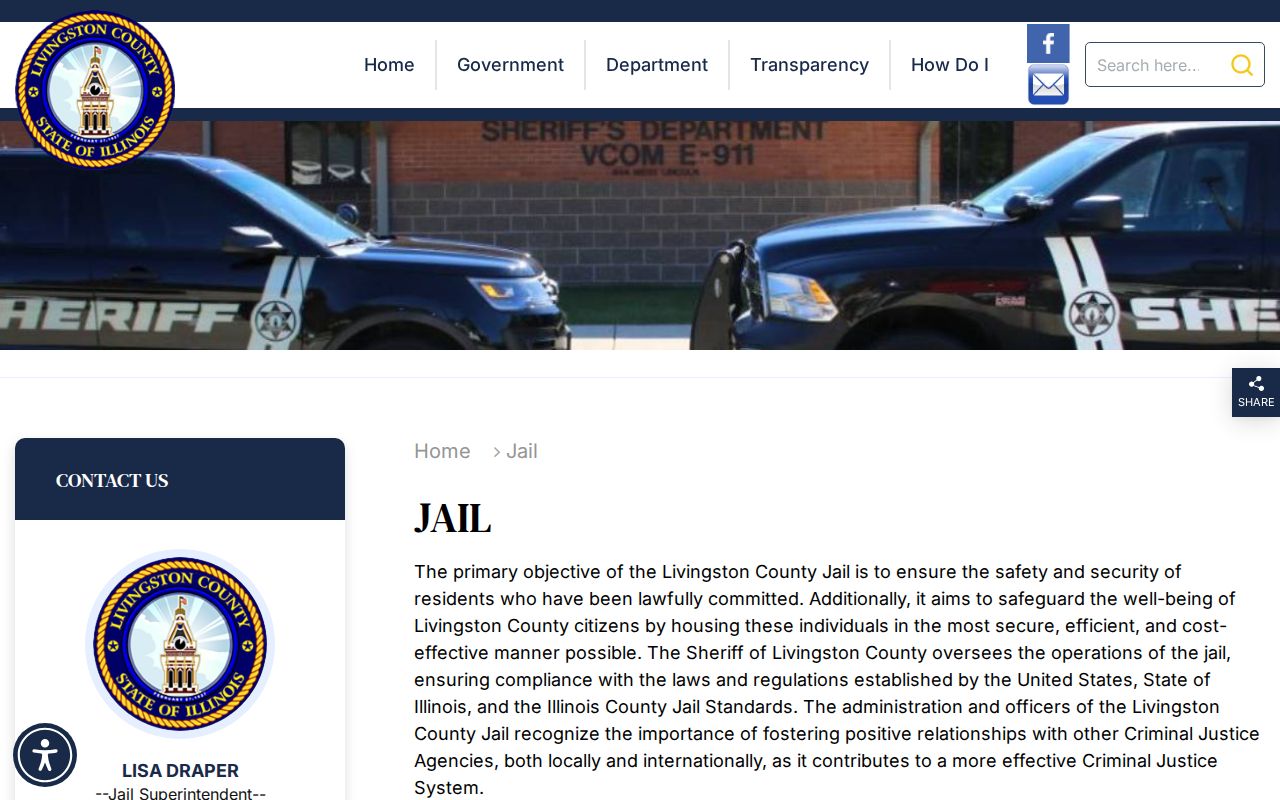
The jail page also points to IDOC as a separate option for state custody. That handoff is useful. Keep the two systems apart, though. County bookings and state prison records never merge into one list.
Livingston County Busted Custody
No public roster means every custody question here starts with a phone call. Someone arrested an hour ago might be at the county jail, at another facility, or still in transit. Call 815-844-5774 and ask what the current public procedure is. A third-party listing is not proof anyone is in custody.
After a release, the phone route stops answering the historical question. FOIA takes over there. Name the arresting agency, the date, the custody receipt, any discharge or transfer, and the photo if one exists. That split between current custody and old records is the timing problem to keep in mind.
Livingston County Busted Feed Limits
Livingston County publishes no same-day, 24-hour, 48-hour, or weekly booking feed. Nothing official says when entries post. Weekend delays? Unknown. So is how long a photo stays up. The older Sheriff press-release category still sits online with posts from the 2017 period. Read it as a historical archive, not a live intake log.
The current Dwight Police Calls post offers weekly PDFs of local reporting. That can help you pin down a date or an incident. It cannot promise that every booking appears or that any photo exists. The Paper is local news, nothing more.
When a page is missing, work through the record's age. Start with the arresting agency, then the Jail, then FOIA, then Judici. A release can drop someone from a current custody view while the booking record stays in the custodian's files. Retention rules are not public, so no fixed archive promise applies here.
Livingston Press Archive Limits
The old Sheriff press-release archive has real value for history. Its visible entries reach the 2017 period. Nothing there proves a current booking cadence. A press release can describe an arrest without ever becoming a roster row, and an archive page can sit online long after the custody it described has changed.
So keep the two eras separate. The current county website handles present-day contacts and FOIA routing. The old site earns a mention only with its date and its historical role stated plainly.
Illinois DOC Offender Photos
A Livingston County arrest can lead to state custody or parole. When it does, the Illinois Department of Corrections offender search is the right tool. IDOC's FAQ lists what the public search returns: a name, an IDOC number, the parent institution or status, vital statistics, admission and release dates, and sentencing information. Discharged people drop out entirely. For them, IDOC provides a separate archive plus a contact route.
Do not mistake IDOC for a recent-arrest feed. A county booking can end before any state sentence. It can stay in county custody or move through a different transfer. The photo process is its own track. IDOC Directive 01.07.808, effective July 1, 2026, covers admission, frontal and profile images, storage, review, updates, and release or discharge photos. It never promises that each public result displays every image.
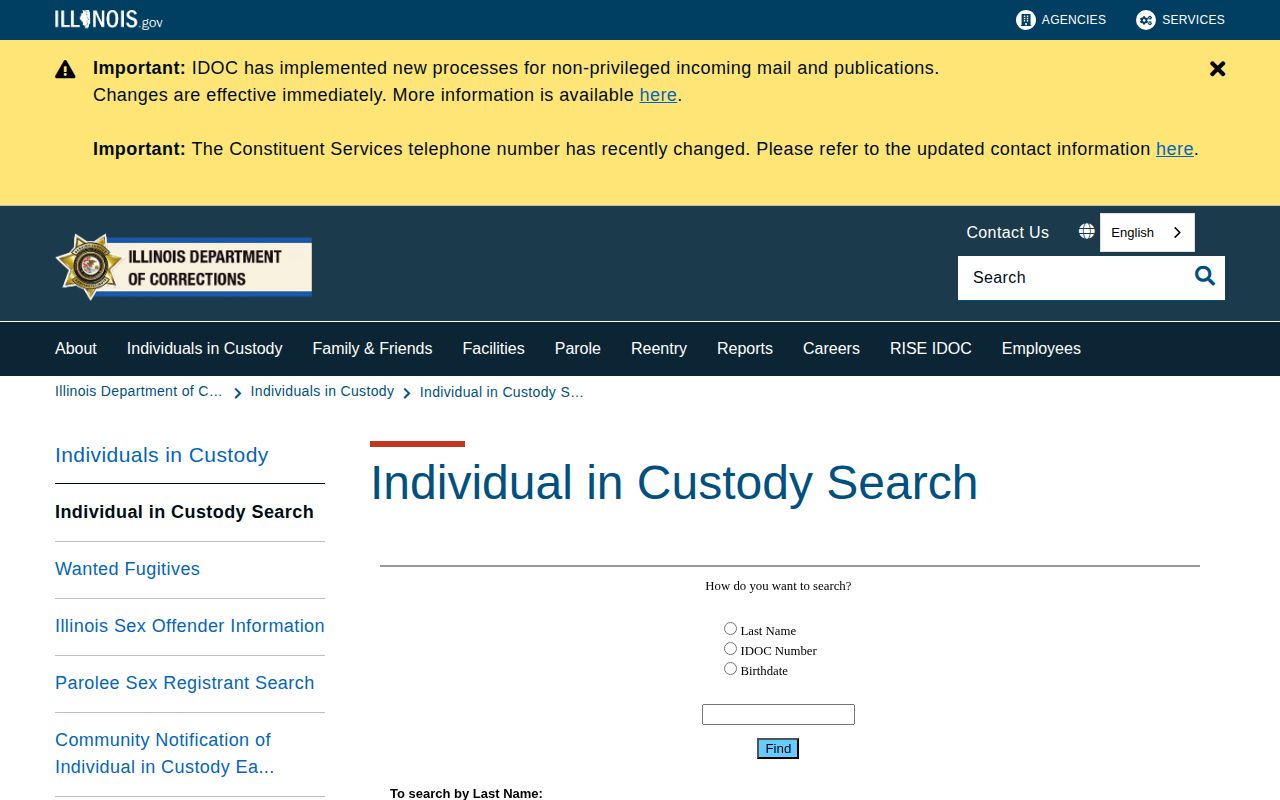
The IDOC search is the correct handoff once a question moves past the county jail. Before that point, it answers nothing.
The IDOC FAQ also mentions Automated Victim Notification and VineLink. Those services cover eligible state-custody or release notices. They are not a county booking alert, and they cannot replace a jail record.
Booked vs Busted Records
Custody status decides which office can actually help you. A current jail inquiry is not a history search. A police report is not a jail receipt. A state DOC profile is not a county booking photo. The comparison below keeps each of these records in its own lane.
| Status | Likely record location | What it can answer |
|---|---|---|
| Just arrested | Arresting police agency or Sheriff | Whether an arrest event was recorded and which agency made it. |
| Received at county jail | Livingston County Jail | Custody receipt and any booking record or photo held by the custodian. |
| Released or transferred | FOIA custodian, jail, police, or next facility | Past arrest, booking, discharge, or transfer fields if retained. |
| Case filed | Circuit Clerk and Judici | Hearings, minutes, charges, dispositions, and sentences when public. |
| State prison or parole | IDOC | State custody, status, and public profile fields. |
| Federal or ICE custody | BOP, ICE, or responsible federal office | Federal custody location or detainee status, not a county mugshot. |
An empty search is not always what it looks like. The person may have been released or moved to another county's jail. Some files are sealed, some involve juveniles, and some data simply posts late. A blank page can even mean there was never a match at all. So treat a no-result search as a starting point, not the last word on anyone's arrest record.
Livingston County Courts After Booking
Want to know what happened after an arrest in Livingston County? Start with the Livingston County Circuit Clerk. The Clerk sends searchers to Judici for public case files. The county's court code there is IL053015J. Punch that in and, depending on what the case makes public, you can pull up hearings, charges, court minutes, dispositions, sentences, fines, and fees. It is the best way to follow a matter from booking into the courtroom.
A few terms make the trip easier. An arraignment is the first big court date, where charges get addressed and release conditions may be set. Bond is a court-ordered condition for release, sometimes money and sometimes something else. The disposition is how it all ends. Knowing these helps you keep the jail roster separate from the court record, since they answer different questions.
- Booking
- Intake after arrest, including the record and possible photograph.
- Arraignment
- An early court appearance involving the filed charge and next legal steps.
- Bond
- A court-set release condition, financial or otherwise.
- Disposition
- The later result, such as dismissal, acquittal, plea, or conviction.
- Expungement
- A court process that can remove eligible records under Illinois law.
Livingston County Judici Court Code
Judici matters here for one reason. The Livingston County Jail does not post a public roster. That leaves the court code as your practical path after a booking. Search the code, match the person and case details carefully, and go through the Circuit Clerk when you need a certified copy. The court file tells you the outcome of a case, nothing more.
One more thing about timing. The arresting agency, the jail, the clerk, and Judici each update on their own schedules. A blank early result in one system can simply mean nobody has entered it yet. Treat each source as its own record.
Federal Busted Custody Boundaries
Here is a wrinkle worth knowing. Livingston County houses and transports people for Federal Marshals under an intergovernmental agreement, according to the current Jail page. No federal detainee roster, booking-photo page, or list of holds gets published, though. And someone held under that deal may not show up in IDOC, because county, state, and federal systems do not talk to each other.
For federal custody, use the Bureau of Prisons locator within its coverage. For an immigration question, try the ICE Online Detainee Locator. Note that the BOP tool gives you custody search fields only, not booking photos. A missing county result tells you nothing about a federal hold or anyone's immigration status.
Federal Marshals Custody
Federal Marshals custody draws a boundary around what Livingston County can tell you. It creates no new public booking source. County staff can explain their own procedure, but the federal agency controls the underlying status. If you request a detainer or hold record, ask the custodian to name the record and cite the proper exemption instead of guessing.
Keep four things straight: the county intake, the state profile, the federal locator, and the court case. Each is a separate record. Never use one to fill a gap in another.
Livingston County Jail Care
The Jail page spends most of its space on care rather than counts. It describes services for people lawfully committed to custody. Those include federal and Illinois standards, transportation, mental and behavioral-health support, rehabilitation groups, and an on-site mental-health provider. Good context for the facility, yes. But it says nothing about how many people are booked or held right now.
An older Sheriff page once listed a rated capacity of 179. Treat that as history, not as today's population, limit, or intake figure. For current custody questions, call the Jail directly.
Juvenile Livingston Records
Illinois arrest-data law builds in confidentiality rules. Exemption limits exist too. Juvenile material and other protected data are not the same as missing adult records. So an empty search result can mean several things. It could be a legal restriction, an exempt field, a sealed matter, or a file held elsewhere.
Don't copy names or images from an unofficial index to fill that gap. Ask the responsible office what public procedure applies. The court route is the lawful way to a later result.
Illinois Busted Expungement Forms
Two state resources handle expungement and sealing in Illinois. Illinois Courts maintains the approved forms. The Illinois State Appellate Defender offers information plus assistance contacts. Eligibility under 20 ILCS 2630/5.2 depends on the specific facts. And a dismissal or release does not wipe every copy from every system on its own.
A court order changes that. Once it issues, the Illinois State Police explains that copies go to the state police, the prosecutor, the arresting agency, and other listed recipients. ISP also notes it does not control every agency. Hold onto your file-stamped order, and send it to any secondary publisher still showing an inaccurate or outdated entry.
State Alerts vs Busted Bookings
Alerts and bookings are not the same thing. The county's pages show no booking-alert subscription. There is no Sheriff mobile app either. The Sheriff page links to Facebook, but no verified booking-photo schedule or complete feed exists there. Smart Communications and Visitel handle detainee contact and visitation, not new-booking notices.
Pontiac and Dwight do list NIXLE public-notice paths. IDOC points to AVN and VineLink for eligible state custody or release notices. Each service covers a different agency and custody status. Something urgent about the county? Call the Jail or the arresting agency rather than trusting an unofficial alert list.
IDOC's own information makes the split plain: state notification systems and a county booking feed are two separate things, and one will never substitute for the other.
Illinois Busted Social-Photo Limits
Section 2.15 of the Illinois arrest-data law restricts posting booking photos on social networks for certain lower-level offenses. Exceptions exist for a missing person, a fugitive, or a person of interest. That is why a county Facebook page cannot be counted on to show every mugshot.
A FOIA request and a social post also work differently. The first asks a custodian for a record. The second is just a publication choice by the agency.
Livingston County Busted Copy Fees
Copy fees depend on which office holds the file. Livingston County waives charges for the first 50 black-and-white pages, then bills $0.15 per page, and promises an answer within five business days. Pontiac posts its own first-50-pages rule. Fairbury's fee schedule gets more detailed: $0.15 per page past 50 black-and-white copies, a $1 CD or DVD, $2 for certification, and certified mail at roughly $3 per ounce.
Keep each fee tied to its own office. Fairbury's charges do not apply to a county jail request, and anyone needing color copies, certification, or a large file should confirm the current price first.
Livingston County Busted City Routes
Three incorporated cities anchor the map here: Pontiac, Dwight, and Fairbury. Each one runs its own police records route. A person booked by city police can still land in Livingston County custody, which may create a county jail record too. Don't treat the two files as the same thing, though. The city police report and the county booking record stay separate.
- Pontiac Busted Mugshots follows the full-service Pontiac Police Department, its FOIA path, and the county custody handoff.
- Dwight Busted Mugshots explains the police records route and The Paper’s weekly police-call reporting.
- Fairbury Busted Mugshots details the city’s FOIA form, fee schedule, and the absence of a verified city blotter.
Streator appears on the list of law-enforcement partners. Yet only a slice of the city sits inside this county. Most of it lies in LaSelle County. So before assuming a Streator arrest belongs here, look at which agency made the stop and where the person was actually held. The custody location tells you which county's busted records to search.
Streator's County Boundary
The county hazard plan draws the line clearly: only a small part of Streator reaches into Livingston County, and the rest of the city belongs to LaSalle County. That boundary matters for records. A Streator police entry, a court case, or a third-party page could all belong to a different county's system.
Three details settle it. Check the arresting agency, the jail that received the person, and the court code on the case. A neighboring county page is never a Livingston source.